
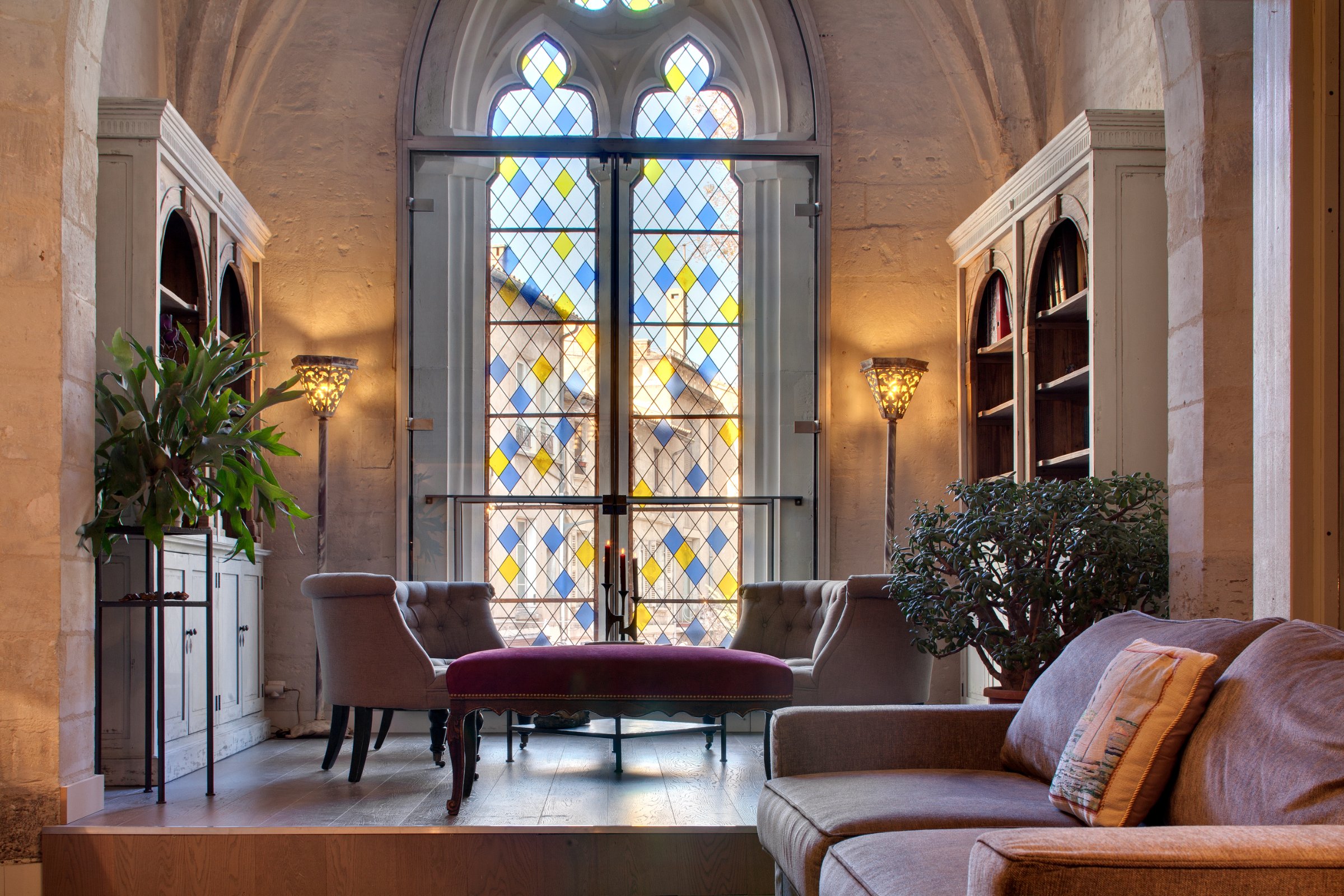
In the 13th century, the Hermits of Saint William settled outside the walls of Avignon, near the «Portail des Mathérons», and were, around 1261, replaced by the Augustinians. The latter obtained, in 1289, from Pope Alexander IV, authorization to live in towns, and the commune of Avignon having granted them an esplanade planted with elm trees, in front of the same gate, they built a convent there, and a church.
The elms from the site were used for the church’s framework. Its bell tower was built by Jacques Laugier in 1372. The bell tower received a clock in 1497. In 1511, Martin Luther, on his way to Rome, stopped and preached with the Augustinians of Avignon, to whose order he belonged. In 1516, Francis I and in 1574, Henry III held the general assembly of the Estates of the kingdom in the Augustinians« refectory. The church was consecrated on August 4, 1517, under the patronage of the Virgin and Saint Augustine. It had 22 chapels. On February 7, 1791, because of the cold and frost, a »Federation camp” was held in the church of the Augustinians, bringing together 12,000 souls, 30 communes and 32 flags; Richard, the first mayor of Avignon, read from the pulpit a decree making this city and the Comtat Venaissin the 84th department of France, called Vaucluse. A few months later, the furniture, belongings and ornaments of the Augustinians were sold and the monks dispersed; their property, having become national property, was handed over to pillage. On July 16, 1796 the convent was sold at public auction except for the bell tower.
Today, these walls still tell captivating stories, between religious heritage, royal power and revolutionary upheavals. Come walk in the footsteps of this history, admire the architecture and feel the atmosphere of a site steeped in memory.
A stay that will take you back in time and help you discover an essential facet of Avignon that you will find nowhere else.
(Source: excerpts from the Dictionary of the streets, squares and buildings of Avignon compiled by Adrien Marcel)